
Wat Suthat Thep Wararam
Wat Suthat, also popularly known as Wat Suthat, is a first-class royal temple of the Rajavoramahavihara type, one of only a few in Thailand. It is considered the royal temple of King Ananda Mahidol (Rama VIII).
Located in the inner city of Phra Nakhon, its most prominent feature is the Giant Swing (Sao Chingcha) located in front of the temple.
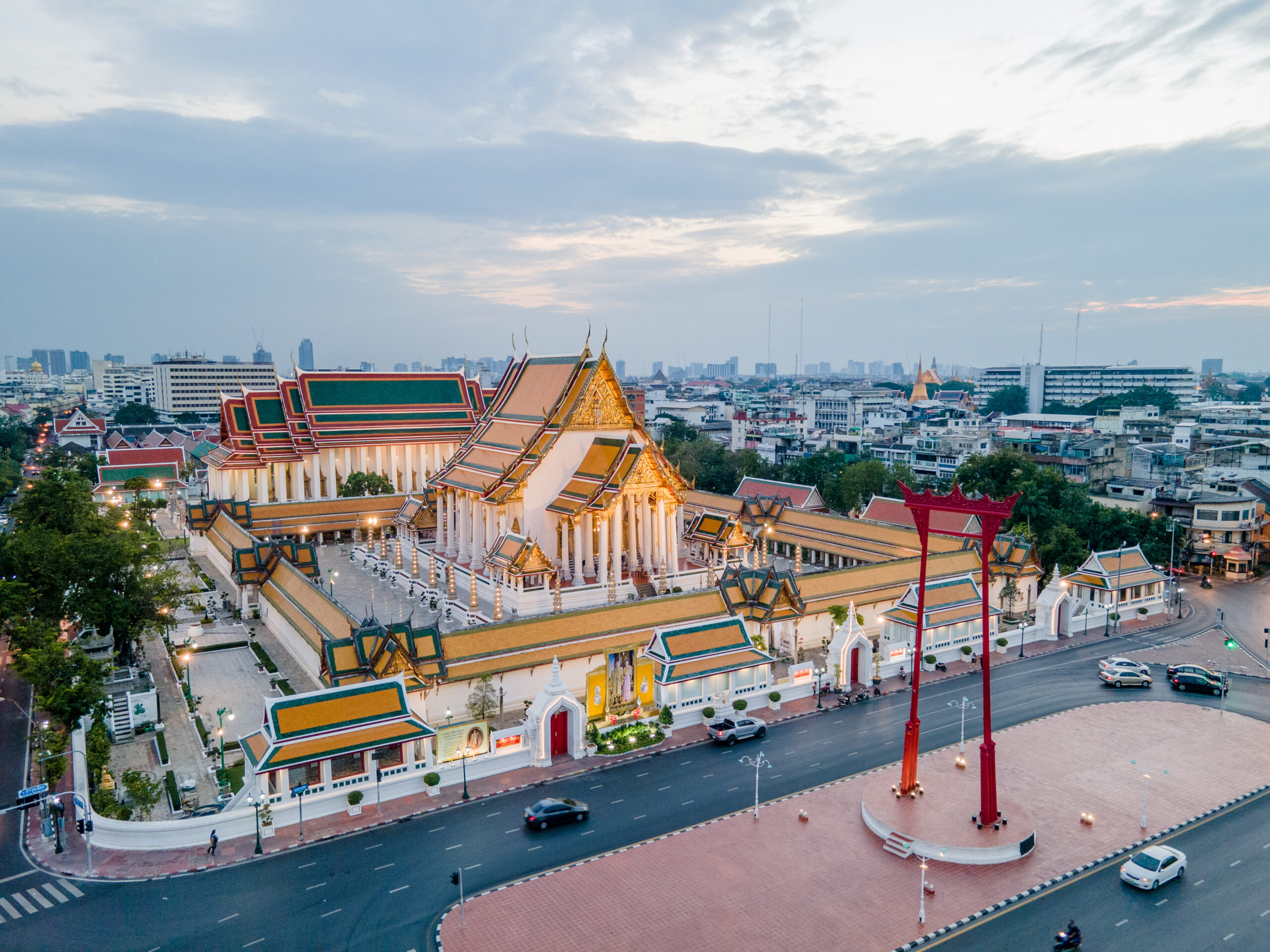
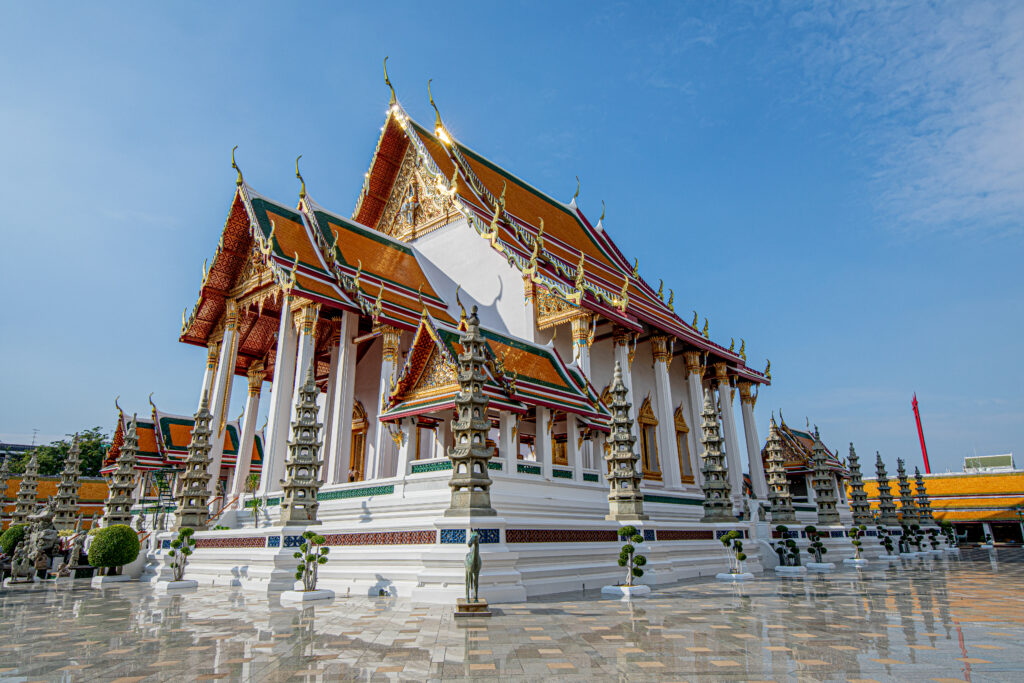
In the early Rattanakosin era, King Rama I ordered the construction of a temple in the inner city of Bangkok in 1807. Originally named “Wat Mahasutthawas,” it was situated in a low-lying area within a Sakae forest. The King ordered the land filled and the temple built, initially constructing the main chapel to enshrine the Phra Sri Sakyamuni (Phra To), a large Buddha image brought from Wat Mahathat in Sukhothai. However, his reign ended before the temple was fully established, leading to it being known as Wat Phra To, Wat Phra Yai, or Wat Sao Chingcha. During the reign of King Rama II (Phra Phutthaloetla Naphalai), construction continued, with the King personally inscribing the doors of the main chapel. However, he also passed away before the construction was completed.
The temple was finally completed during the reign of King Rama III (Phra Nangklao) in 1847, and given the name “Wat Suthat Thepwararam.” Historical records indicate… Wat Suthat Thep Wararam was established during the reign of King Rama IV (King Mongkut). He bestowed names upon the principal Buddha images in the main chapel, ordination hall, and sermon hall, naming them “Phra Sri Sakyamuni,” “Phra Phuttha Trilok Cheth,” and “Phra Phuttha Sretthamuni.”
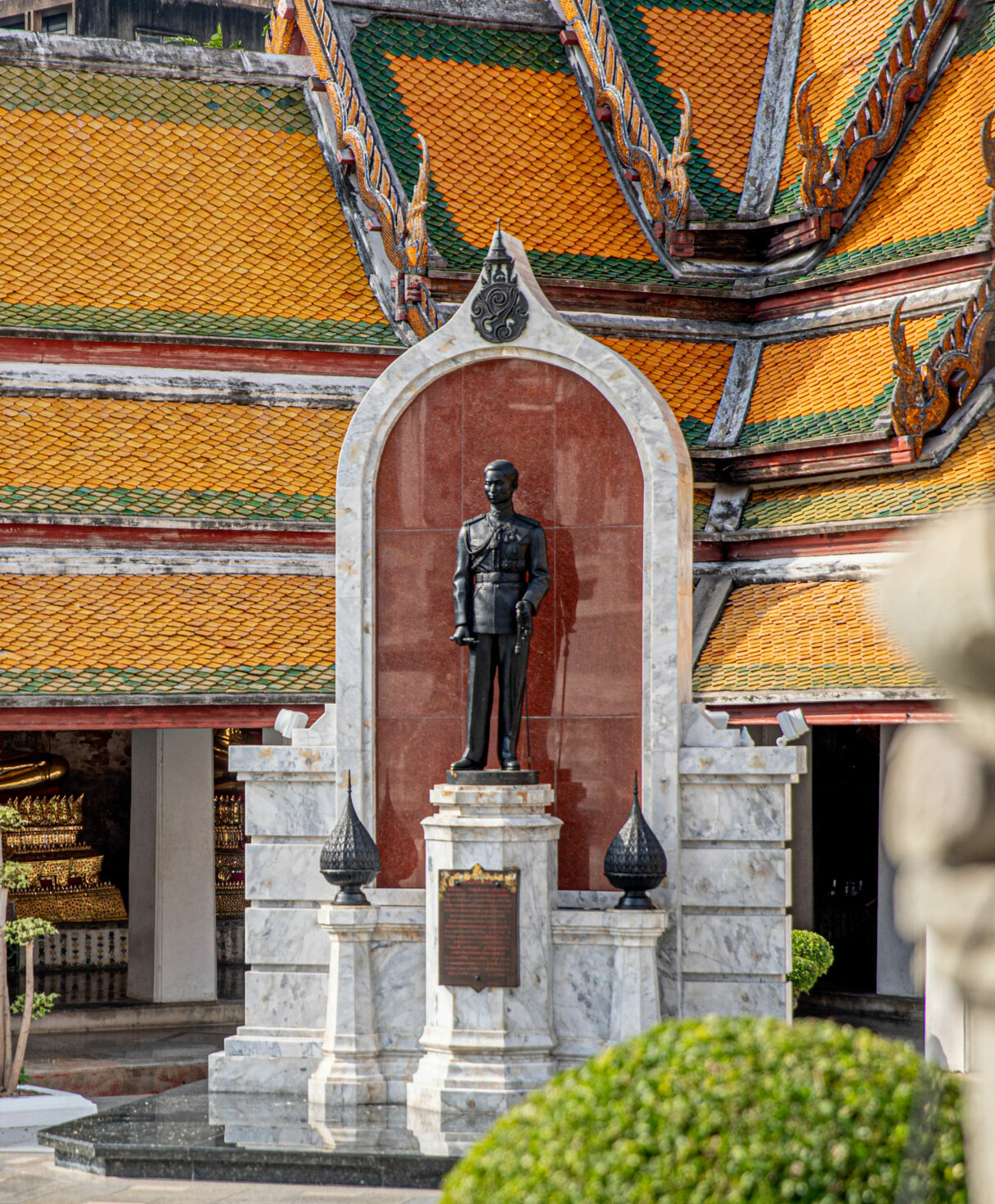
Within Wat Suthat Thep Wararam is enshrined the royal monument of King Ananda Mahidol, and his royal ashes were placed in the sacred cloth in front of the Buddha image of Phra Sri Sakyamuni in 1950. A royal ceremony is held annually on June 9th to commemorate the anniversary of King Ananda Mahidol’s death.
On August 31, 2023, the Fine Arts Department designated Wat Suthat Thep Wararam as a historical site. The area designated as a historical site shall consist of 28 rai and 76 square wah.
Buddhist Temple
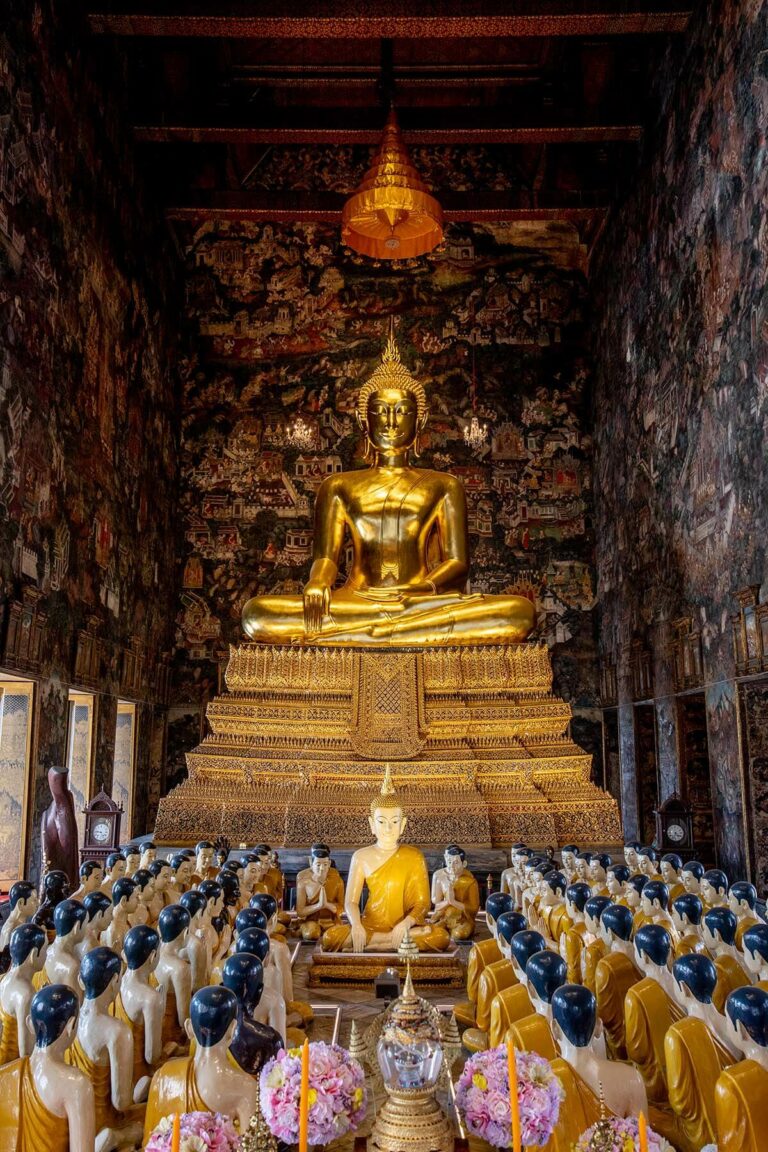
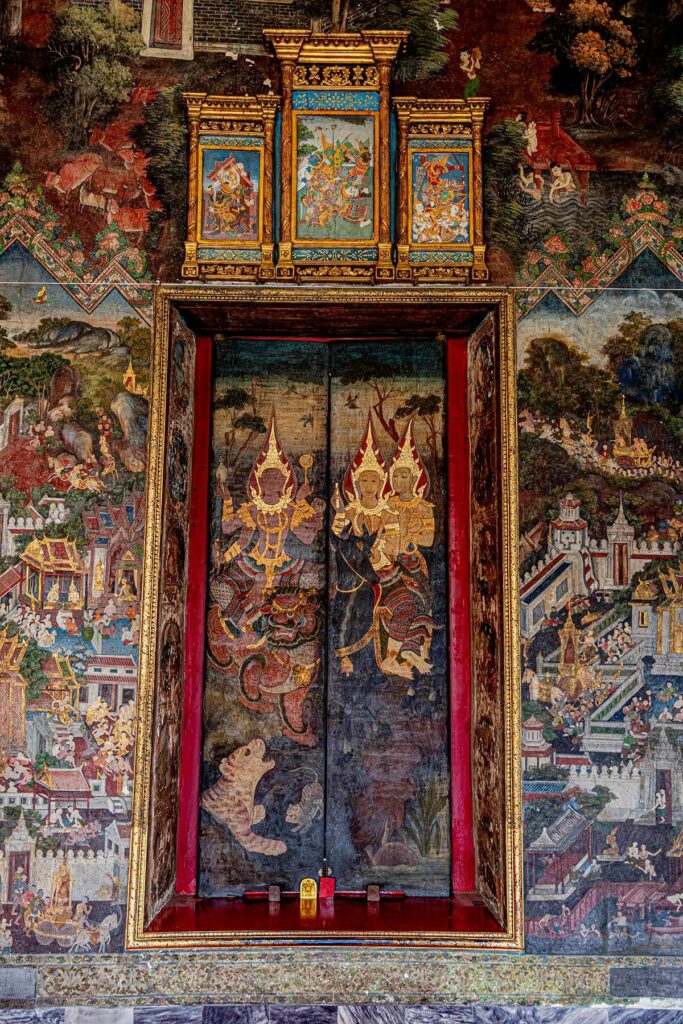
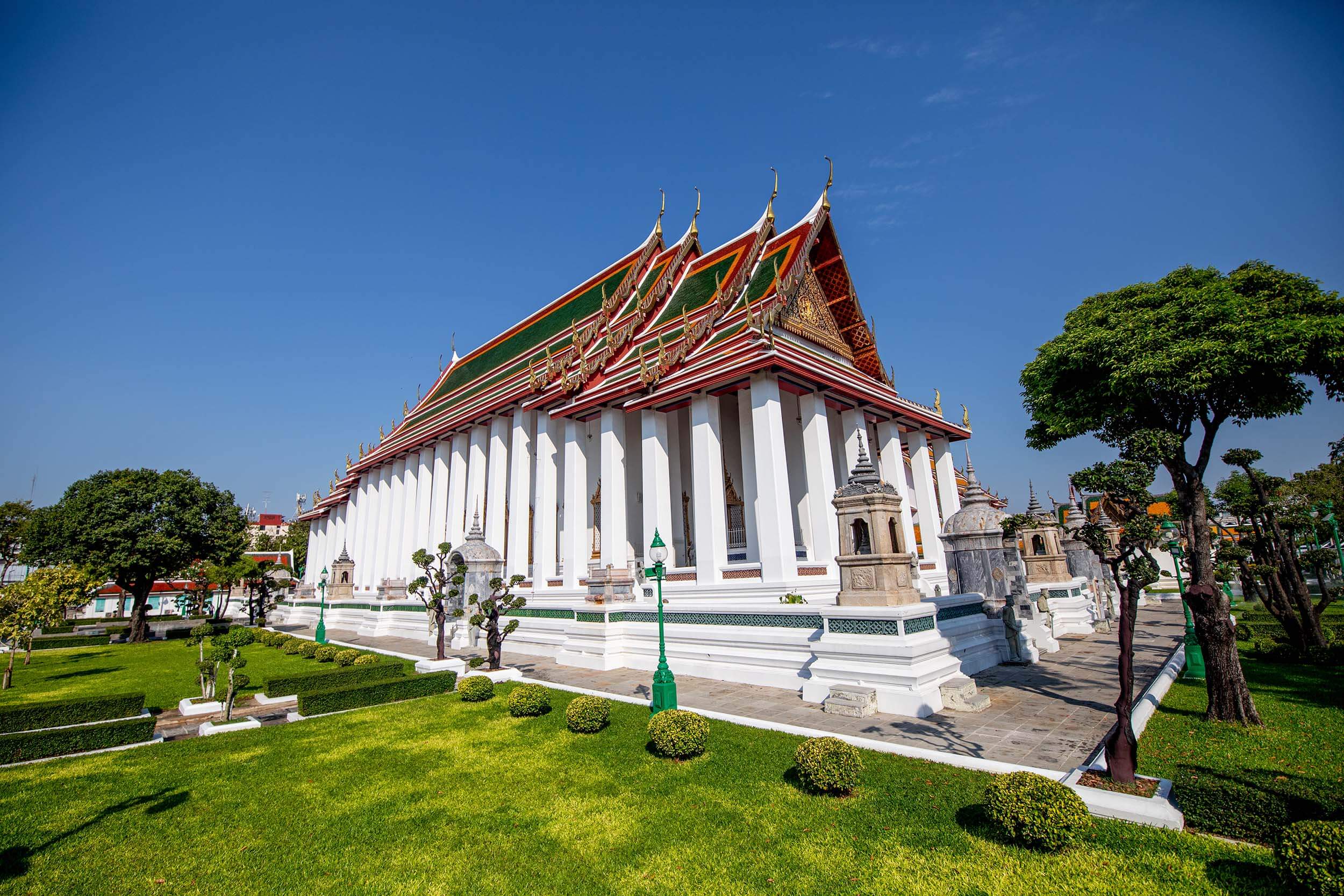
The main chapel of Wat Suthat is considered the longest ordination hall in Thailand. The principal Buddha image inside is Phra Phuttha Trilok Cheth, a Buddha statue in the Maravijaya posture. Both the chapel and the Buddha image were built during the reign of King Rama III. The inner walls of the chapel feature murals painted by artisans of the same period. The doorways and windows have unique and beautiful pagoda-shaped arches. Around the chapel are eight boundary markers (sema) on the surrounding wall. These are pairs of sema made of gray marble, carved with images of three-headed elephants, each trunk holding a lotus bud, with three blooming lotus flowers above. On the north and south sides of the wall, there are four platforms (gei) on each side, used for the King to distribute alms to the public during royal ceremonies; these are known as “alms-giving platforms”.
Ghost of Wat Suthat
At Wat Suthat Thep Wararam Ratcha Woramahawihan, there are stories about hungry ghosts (Pret), creatures believed to reside in the lower realms according to Buddhist and Thai beliefs. It is said that Prets once appeared here. This story may stem from a famous painting on a pillar inside the main chapel, located near the statue of Phra Sri Sakyamuni. This painting, created during the reign of King Rama III, depicts a hungry ghost lying down while a monk stands contemplating its impermanent state. It was widely rumored that anyone visiting the main chapel to pay respects to Phra Sri Sakyamuni should see this famous painting, “The Pret of Wat Suthat,” leading to the rhyming saying, “Vultures of Wat Saket, Prets of Wat Suthat.”
Furthermore, there are oral traditions recounting that in the past, hungry ghosts were frequently sighted at night in front of the main chapel. It is said that Somdej Phra Ariyavongsakhatayan, the Supreme Patriarch (Pae Tissadevo), while serving as abbot of Wat Suthat, once spoke to a hungry ghost around 9 PM, saying, “Let’s stay together.” “Don’t let the villagers be troubled.” After that, the ghost did not appear again.
It is also possible that the ghost of Wat Suthat was a misunderstanding by those who saw the swing pole in front of the temple in the early morning when there was fog or poor visibility, and mistook it for a ghost. Or it may have originated from one of the royal writings of King Rama VI, who once wrote “The Ghost of Saphan Han,” in which he compared the beggars at Saphan Han to ghosts, and this was then compared to the beggars living in front of the Brahmin temple nearby.